
How to Qualify for and Claim R&D Tax Credits as a Non-Resident US Business Founder

1. Understanding the R&D Tax Credit
The research and development (R&D) tax credit is a powerful incentive offered by the US government to promote innovation among businesses. Specifically designed to stimulate the economy, it allows startups and established companies to reduce their federal tax liabilities by engaging in scientific research and development activities. This credit is particularly beneficial for founders outside the United States who wish to incorporate and grow their business within the US.
Established under Section 41 of the Internal Revenue Code, the R&D tax credit provides a dollar-for-dollar tax reduction for eligible research and development expenditures. This means businesses can significantly cut down their tax bills if they invest in product development, design innovation, or scientific research that meets specified criteria.
Key Fact: The US government allocates billions of dollars annually to support businesses through R&D tax credits, encouraging technological advancements and economic growth.
Individual states also offer their own R&D credits, which can vary widely. For instance, Maryland caps its state-level R&D tax credit at $12 million, with specific allocations for small businesses, whereas California sets a cap at $5 million.
2. Who Is Eligible for the R&D Tax Credit?
Understanding eligibility is crucial for any business planning to claim the R&D tax credit. Regardless of size or industry, any company can potentially qualify for this incentive, provided its activities align with the defined criteria.
However, there are specific conditions to be aware of, especially for businesses owned by non-residents. If your business is a single-member LLC owned by a foreign individual, it won't qualify for the R&D tax credit because US tax residency is a requirement. Similarly, partnerships must have US taxpayer partners to benefit from the credit.
For partnerships, the R&D tax credit flows to individual partners, who then report it on their personal tax returns. Non-US partners, not subject to American income tax, will not be able to utilize these credits directly. Still, unused credits can be carried forward for up to 20 years, offering future tax relief potential.
2.1 Four-Part Test for Eligibility
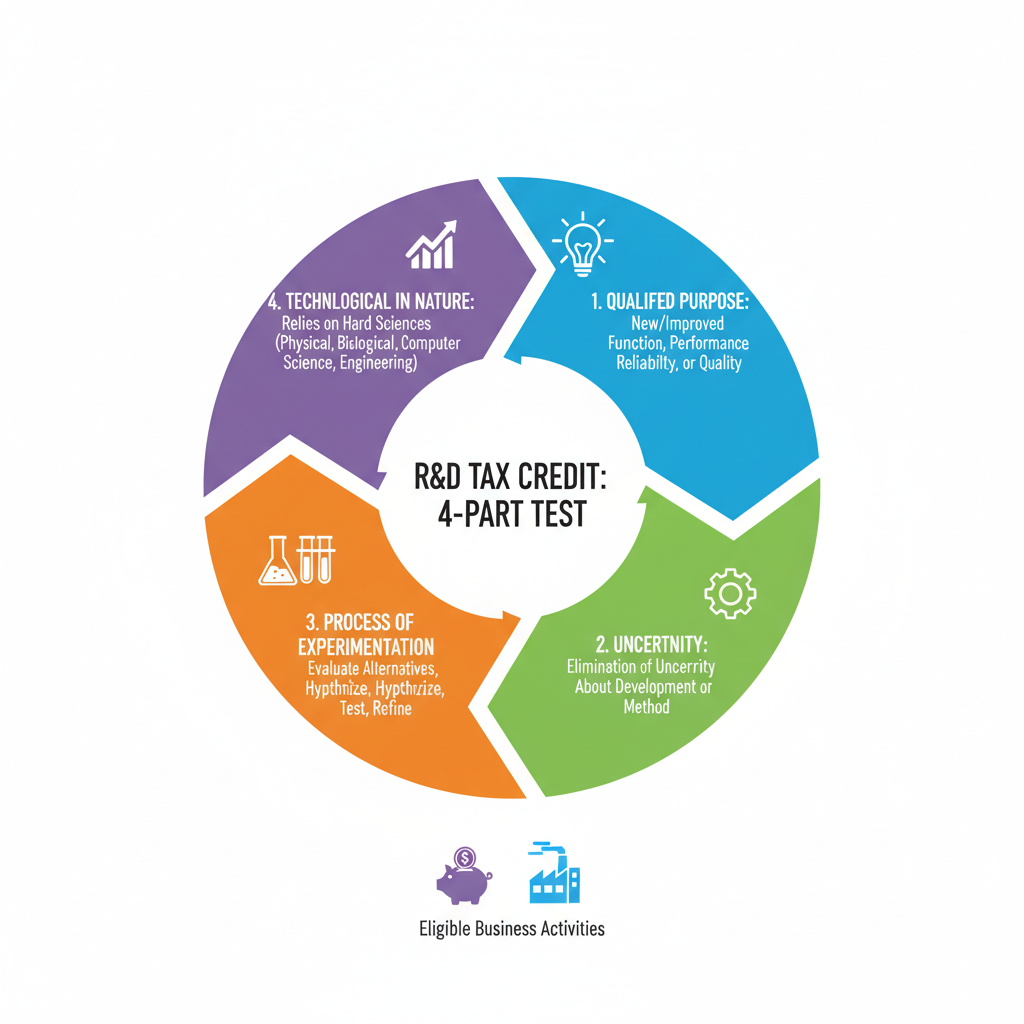
The IRS employs a four-part test to ascertain the eligibility of research activities for the R&D tax credit. These are:
- New or Improved Business Component: Activities must focus on developing or enhancing a business component such as a product, process, or software.
- Technological in Nature: The research should be based on hard science principles like engineering or computer science, not soft sciences like psychology.
- Elimination of Uncertainty: The research must aim to resolve technical uncertainties.
- Process of Experimentation: A systematic method of experimentation to resolve uncertainties must be evident.
Note that research conducted outside the US, funded by third parties, or routine efficiency tasks are excluded from this credit.
The R&D tax credit can be a game-changer for international entrepreneurs looking to establish a US-based business. Services like FastLLC can facilitate the formation of your company, ensuring compliance with all requirements, including obtaining an EIN, which is essential for claiming tax credits.
3. Common Exclusions from the R&D Tax Credit
While the R&D tax credit aims to reward innovation, certain activities are explicitly excluded from qualifying:
- Foreign Research: Any research conducted outside of the US does not qualify, even if by American researchers.
- Funded Research: Research financially backed by a third party won't qualify unless the company bears the risk or retains substantial rights.
- Adaptation of Existing Components: Modifying existing products to meet specific client needs is not eligible.
- Routine Efficiency and Management Tasks: Administrative activities, training programs, or efficiency improvements driven by management decisions are excluded.
4. How to Claim the R&D Tax Credit
Claiming the R&D tax credit involves several steps and requires meticulous documentation to support your claim.
4.1 Required Documentation
To substantiate the R&D tax credit claim, businesses must gather specific documents:
- Employee Wage Documentation: Records such as W-2 forms, timesheets, and payroll registers.
- Contractor Expense Documentation: Invoices, 1099 forms, and contracts detailing work scope.
- Suppliers and Materials Documentation: Material receipts, invoices, and ledger entries.
- Lease and Rent Agreements: Documentation for leased research equipment.
4.2 Completing Form 6765
Form 6765 is crucial for claiming the R&D tax credit. It includes sections like:
- Section A: Regular Credit for detailed expenses and base amounts.
- Section B: Alternative Simplified Credit for those lacking historical data.
- Section C: Current Year Credit to adjust overlapping credit claims.
- Section D: Payroll Tax Election for startups with limited taxable income.
Each section requires specific documentation to back your claims, and precise completion is mandatory to avoid errors and potential penalties.
4.3 Ramifications and Considerations
While beneficial, claiming the R&D tax credit can increase IRS scrutiny due to its complexity. Keep thorough records for the statute of limitations, and be cautious not to double-claim expenses or credits. If ownership changes significantly, you might lose the ability to carry forward unused credits.
5. Maximizing Your R&D Tax Credit with FastLLC
At FastLLC, we understand the challenges faced by non-resident founders when navigating US tax credits. Our services not only assist in forming your LLC but also ensure you are equipped to handle tax-related matters efficiently.
Our team is dedicated to simplifying the process of claiming R&D tax credits. Just provide the necessary documentation, and we'll handle the submission, maximizing your potential credit at industry-leading rates.
6. Conclusion: Taking the Next Step
The R&D tax credit is a substantial benefit for businesses aiming to innovate and grow. For non-resident founders seeking to establish a US presence, understanding and leveraging this credit can significantly impact their business's financial health.
Consider collaborating with a formation service like FastLLC to facilitate your entry into the US market. By focusing on essential steps such as obtaining an EIN and adhering to IRS guidelines, you can ensure a smooth pathway to claiming the R&D tax credit.
Take the first step today by exploring your business formation options and preparing to unlock the potential of the R&D tax credit.
7. Real-World Examples of Companies Benefiting from R&D Tax Credits
To better understand the impact of the R&D tax credit, let's explore how real-world companies have leveraged this incentive to drive innovation and growth.
7.1 Tech Startups
Many tech startups use the R&D tax credit to offset costs associated with software development and technological advancements. For instance, a small software company developing an AI-driven platform for business analytics might spend heavily on programming and testing. By utilizing the R&D tax credit, they can recover a portion of these expenses, allowing them to reinvest in further development and expansion.
7.2 Manufacturing Firms
Manufacturing companies often engage in R&D to improve processes and product offerings. A mid-sized firm producing eco-friendly packaging materials could claim the credit for developing new biodegradable materials. This credit enables them to reduce production costs and enhance their competitiveness in the market.
7.3 Biotech Innovators
Biotechnology companies frequently invest in research to create new drugs and medical devices. An emerging biotech firm working on a groundbreaking cancer treatment can utilize the R&D tax credit to fund clinical trials and research personnel, accelerating the pathway to commercialization.
8. Common Mistakes When Applying for R&D Tax Credits
Applying for R&D tax credits can be complex, and businesses often make mistakes that could lead to denied claims or penalties. Here are some common pitfalls to avoid:
8.1 Inadequate Documentation
One of the most frequent errors is insufficient documentation. Companies must maintain detailed records of research activities, including project descriptions, employee tasks, and associated costs. Failing to provide comprehensive evidence can result in the denial of the credit.
8.2 Misclassifying Activities
Businesses sometimes mistakenly categorize non-qualifying activities as eligible research. For example, routine data analysis or quality control procedures do not meet the IRS criteria for R&D tax credits. Clear differentiation between eligible and ineligible activities is crucial.
8.3 Overlooking State-Level Credits
While focusing on federal credits, companies may overlook additional state-level R&D tax credits. These can significantly enhance overall tax savings. Businesses should explore incentives offered by their state to maximize benefits.
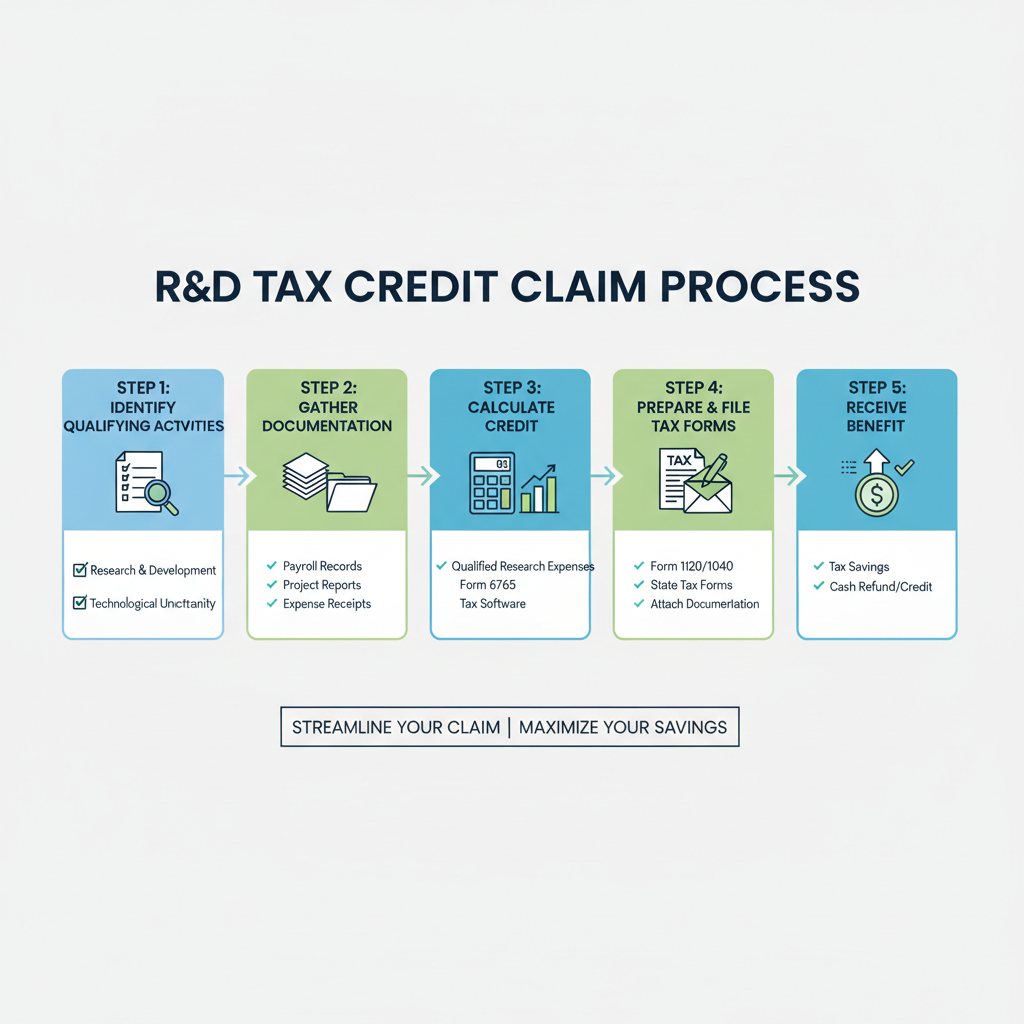
9. A Step-by-Step Guide to Preparing Your R&D Tax Credit Claim
Successfully claiming the R&D tax credit involves following a structured approach. Here’s a step-by-step guide to help you prepare:
- Identify Qualifying Activities: Review your company's projects to identify activities that meet the IRS's four-part test for eligibility.
- Gather Documentation: Collect all necessary documentation, including payroll records, project notes, and financial statements that support your claim.
- Calculate Expenses: Accurately calculate qualifying expenses, such as wages, supplies, and contractor costs, ensuring they are directly related to R&D activities.
- Complete Form 6765: Fill out IRS Form 6765, detailing your R&D activities and expenses. Consider consulting a tax professional for accuracy.
- Submit Your Tax Return: Include Form 6765 with your federal income tax return, and ensure all information is consistent and complete.
- Retain Records: Keep comprehensive records to support your claim in case of an IRS audit. Maintain these documents for at least three years after your tax return filing.
By following these steps, you can effectively prepare and submit your R&D tax credit claim, maximizing potential benefits for your business.
Frequently Asked Questions
The R&D tax credit is a US federal incentive that offers a dollar-for-dollar reduction in tax liabilities for qualifying research and development activities.
Foreign-owned businesses can claim the R&D tax credit if they meet specific criteria, such as having US tax residency for the owners.
Activities that qualify include developing or improving business components through technological research and experimentation to resolve technical uncertainties.
Required documentation includes employee wage records, contractor expenses, material receipts, and agreements for leased research equipment.
FastLLC can assist with LLC formation and provide guidance and services to ensure you maximize your R&D tax credit claims efficiently.
Share this article



Ready to start your US LLC?
Formation, EIN, registered agent, and ongoing compliance — handled in one place.
Get Started for Free