
How Non-Resident Founders Can File U.S. Tax Returns for Their Company

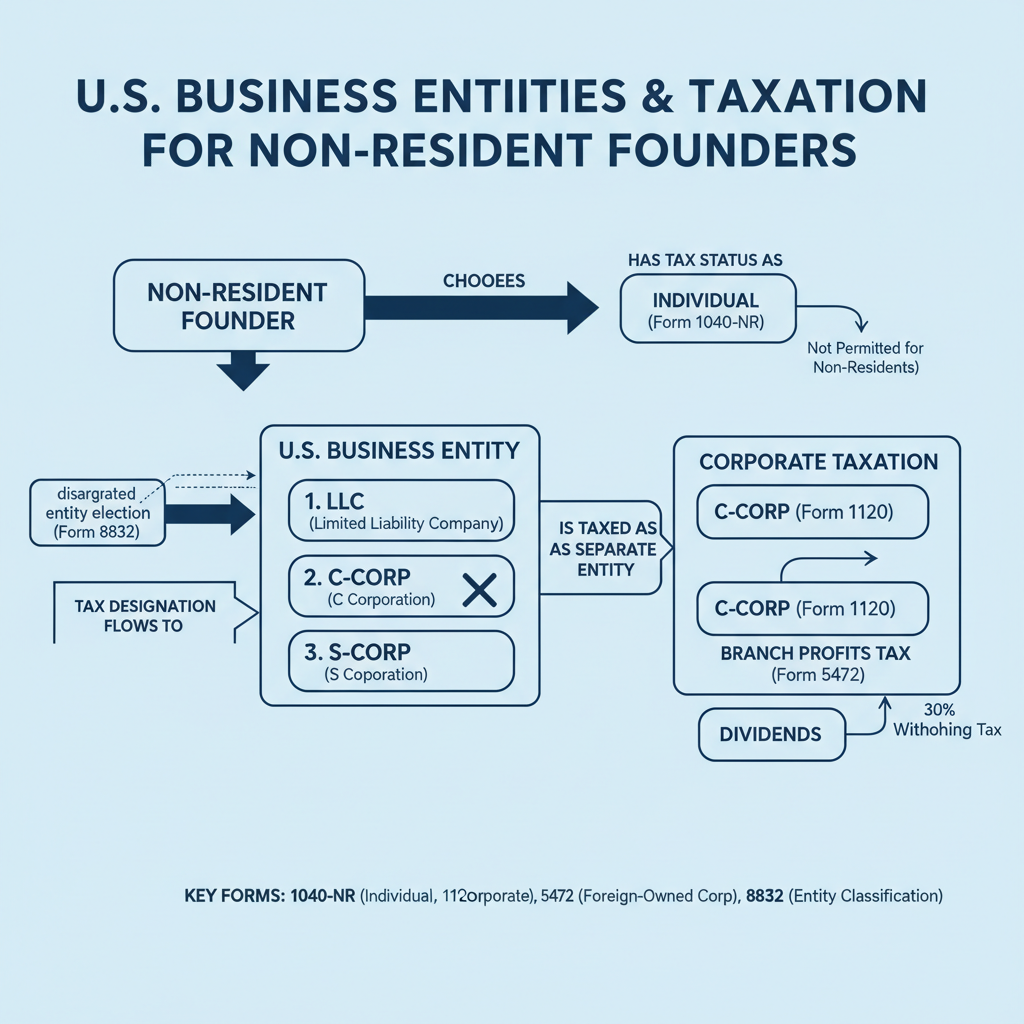
1. Understanding U.S. Business Entities and Tax Designations
Starting a U.S. company as a non-resident founder can provide significant opportunities, but it also involves navigating a complex tax landscape. Understanding the differences between entity types and tax designations is crucial for compliance and financial efficiency.
1.1 Distinguishing Entity Types
When you incorporate in the U.S., the term 'entity' refers to the legal structure of your business. Non-resident founders typically choose between forming a Limited Liability Company (LLC) or a Corporation.
- LLC (Limited Liability Company): This structure offers personal liability protection without the complexities of a corporation. One of its main advantages is the 'corporate veil,' which means members are not personally responsible for the company’s debts.
- Corporation: A corporation is a separate legal entity owned by shareholders. The primary benefit is liability protection, as shareholders are not liable for corporate debts.
1.2 Tax Designations Explained
Tax designations determine how the IRS taxes your entity's income, and they are not tied to the type of legal entity.
- Single-member LLC: Defaulted as a 'disregarded entity,' meaning all income and expenses are reported on the owner's personal tax return.
- Multi-member LLC: Treated as a partnership for tax purposes, requiring each member to report their share of income on personal tax returns.
- C-corporation: This designation applies to corporations and LLCs that elect to be taxed as a corporation, subject to corporate income taxes.
Choosing the right combination of entity type and tax designation is essential for efficient tax management. FastLLC can help guide you in making the most strategic decision.
2. Tax Filing Requirements for Non-Resident Founders
Filing taxes for a U.S.-based company as a non-resident founder involves understanding several federal and potentially state-level requirements. Ensuring all forms are correctly filed is crucial for maintaining good standing with the IRS.
2.1 Essential Federal Tax Forms
- Form 5472: Required for U.S. corporations with substantial foreign ownership. It tracks transactions between the U.S. company and related foreign entities.
- Form 1120: Used by C-corporations to report income, expenses, and tax liabilities.
- Form 1065: Filed by partnerships, including multi-member LLCs, to report income and expenses.
- Form 1099-NEC and 1099-MISC: Needed if you pay U.S.-based independent contractors or make miscellaneous payments.
Failing to file these forms can lead to penalties, so consider using a service like FastLLC to ensure compliance.
2.2 State and Local Tax Filing
Depending on where your company is registered, you may also need to handle state and local tax filings, such as annual franchise taxes or specific state forms. States like Delaware and California have unique requirements that must be met annually.
Consulting with tax professionals or using resources like FastLLC can ease the process and help you stay on track with all obligations.
3. Preparing Documents for U.S. Tax Filing
Having all necessary documents ready is a key step in filing your U.S. company taxes efficiently. Here are some critical documents you'll need to gather:
- Employer Identification Number (EIN): This is your business's tax ID and is essential for filing returns.
- Financial Statements: Includes income statements, balance sheets, and cash flow statements.
- Ownership Proof: Documentation showing your role as owner or shareholder.
- Contractual Agreements: Any contracts with clients, vendors, or partners.
- Payroll Records: Necessary if you have employees, including records of withholding taxes.
Having these documents organized will streamline your tax filing process, whether you handle it independently or through FastLLC’s services.
4. Strategies to Minimize U.S. Tax Liability
As a non-resident founder, strategically minimizing your tax liability can significantly impact your business’s financial health. Here are some approaches to consider:
4.1 Leveraging Tax Deductions
Claiming all eligible deductions can lower your taxable income. Examples include:
- Office supplies and equipment
- Software subscriptions
- Marketing and advertising expenses
- Travel expenses related to business operations
- Home office deductions, if part of your residence is used for your U.S. business
Utilizing these deductions can substantially reduce the amount of tax owed.
4.2 Applying Tax Credits
Tax credits directly reduce your tax liability. For instance, the Research and Development (R&D) tax credit can be beneficial if your company invests in new product development or improvements.
Understanding and applying these credits effectively requires knowledge of tax regulations; hence, consulting with an expert or using a service like FastLLC is advisable.
5. Avoiding an IRS Audit
The prospect of an IRS audit can be daunting, but by adhering to best practices, you can minimize this risk. Here are some strategies:
5.1 Accurate Record-Keeping
Ensure all business transactions are categorized accurately. Misclassifying expenses can raise red flags. Use reliable accounting software to streamline this process and maintain transparency.
5.2 Filing Amendments Cautiously
If you need to file an amended return, ensure all changes are well-documented and justified. Significant discrepancies may prompt scrutiny.
5.3 Realistic Reporting
Always report exact figures rather than rounding them to avoid IRS suspicion. Maintaining precise records is key.
By implementing these practices, you can significantly reduce the likelihood of an audit.
6. Managing Double Taxation Issues
Double taxation can occur when your income is taxed in both the U.S. and your home country. Here’s how to handle it:
6.1 Utilizing Tax Treaties
Tax treaties between the U.S. and other countries can help prevent double taxation. These treaties delineate taxing rights and can be leveraged to reduce tax burdens.
Founders should understand the relevant treaty provisions and may need to submit Form W-8BEN-E to claim treaty benefits.
6.2 Salary Structuring
Paying yourself a salary from your company can mitigate double taxation. Salaries are business expenses, reducing corporate tax liabilities while being taxed as personal income.
Ensure the salary aligns with industry standards to avoid IRS scrutiny.

7. Taking the Next Steps with FastLLC
Navigating the complexities of U.S. tax filing as a non-resident can be challenging. FastLLC offers comprehensive services to help you manage all aspects of your business formation and ongoing compliance needs.
Whether it’s securing an EIN, selecting the correct tax designation, or guiding you through federal and state tax filings, FastLLC provides the expertise to streamline your processes, allowing you to focus on growing your business.
Consider reaching out to FastLLC for personalized support and take the next step towards successfully managing your U.S.-based company’s taxes.
8. Exploring Real-World Case Studies
Understanding theoretical concepts is essential, but seeing them in practice can provide more clarity. Here are some real-world examples of non-resident founders who successfully navigated the U.S. tax landscape.
8.1 Case Study: Startup in Delaware
A tech startup founded by a European entrepreneur chose to incorporate in Delaware due to its business-friendly laws and favorable tax treatment. By forming a C-corporation, the founder accessed increased funding opportunities while leveraging Delaware’s lack of a state sales tax for goods sold outside the state.
With FastLLC’s guidance, the startup structured its operations to optimize tax credits related to research and development, significantly reducing its overall tax burden.
8.2 Case Study: Utilizing Tax Treaties
An Australian entrepreneur running a digital marketing agency established a U.S.-based LLC. By utilizing the Australia-U.S. tax treaty, the founder minimized the impact of double taxation. FastLLC assisted in correctly filing Form W-8BEN-E, ensuring the entrepreneur benefited from reduced withholding rates on U.S.-sourced income.
This strategic approach allowed the founder to reinvest savings into the business, fostering growth and expansion into new markets.
9. Common Mistakes and How to Avoid Them
Even with the best intentions, non-resident founders can make errors that complicate their tax obligations. Here are common mistakes and tips to avoid them:
9.1 Incorrect Entity Selection
Choosing the wrong entity type can lead to unnecessary tax liabilities. For example, a non-resident opting for a corporation without needing the benefits of corporate structure may face double taxation. Consulting with experts like FastLLC before making a decision can prevent costly mistakes.
9.2 Neglecting State Tax Obligations
Many non-residents focus solely on federal taxes, overlooking state requirements. This oversight can result in penalties and interest. Always review both federal and state tax obligations, especially if your business operates in multiple states.
9.3 Inadequate Record-Keeping
Poor documentation can lead to audit triggers and missed deductions. Implementing a robust accounting system early on is crucial. FastLLC can recommend reliable tools to help maintain thorough records.
10. Comprehensive Comparison Table: LLC vs. Corporation
To further assist in decision-making, refer to this comparison table outlining key differences between LLCs and Corporations:
| Aspect | LLC | Corporation |
|---|---|---|
| Ownership | Members | Shareholders |
| Taxation | Pass-through taxation | Double taxation (unless an S-corp) |
| Management | Flexible management structure | Board of directors and officers |
| Compliance | Fewer formalities | More formal requirements |
| Funding | Limited ability to raise capital | Easier to raise capital through stock issuance |
| Liability Protection | Personal liability protection | Personal liability protection |
This table provides a clear overview, helping non-resident founders choose the structure that best aligns with their business goals and tax strategy.
Frequently Asked Questions
A disregarded entity is typically a single-member LLC that is not taxed separately from its owner. All income and expenses are reported on the owner's personal tax return.
Yes, non-residents can form an LLC in the U.S. An LLC provides liability protection and can be taxed in various ways, depending on the owner’s preference.
Form 5472 is used by companies with significant foreign ownership to report certain transactions with related foreign parties to the IRS.
Utilizing tax treaties and structuring your income as a salary can reduce the effects of double taxation. Consulting a tax advisor familiar with international tax law is recommended.
Key documents include your EIN, financial statements, proof of ownership, contractual agreements, and payroll records if applicable.
Yes, having a registered agent is a requirement for forming a business in the U.S. They can be included in a formation plan, such as those offered by FastLLC.
Share this article



Ready to start your US LLC?
Formation, EIN, registered agent, and ongoing compliance — handled in one place.
Get Started for Free